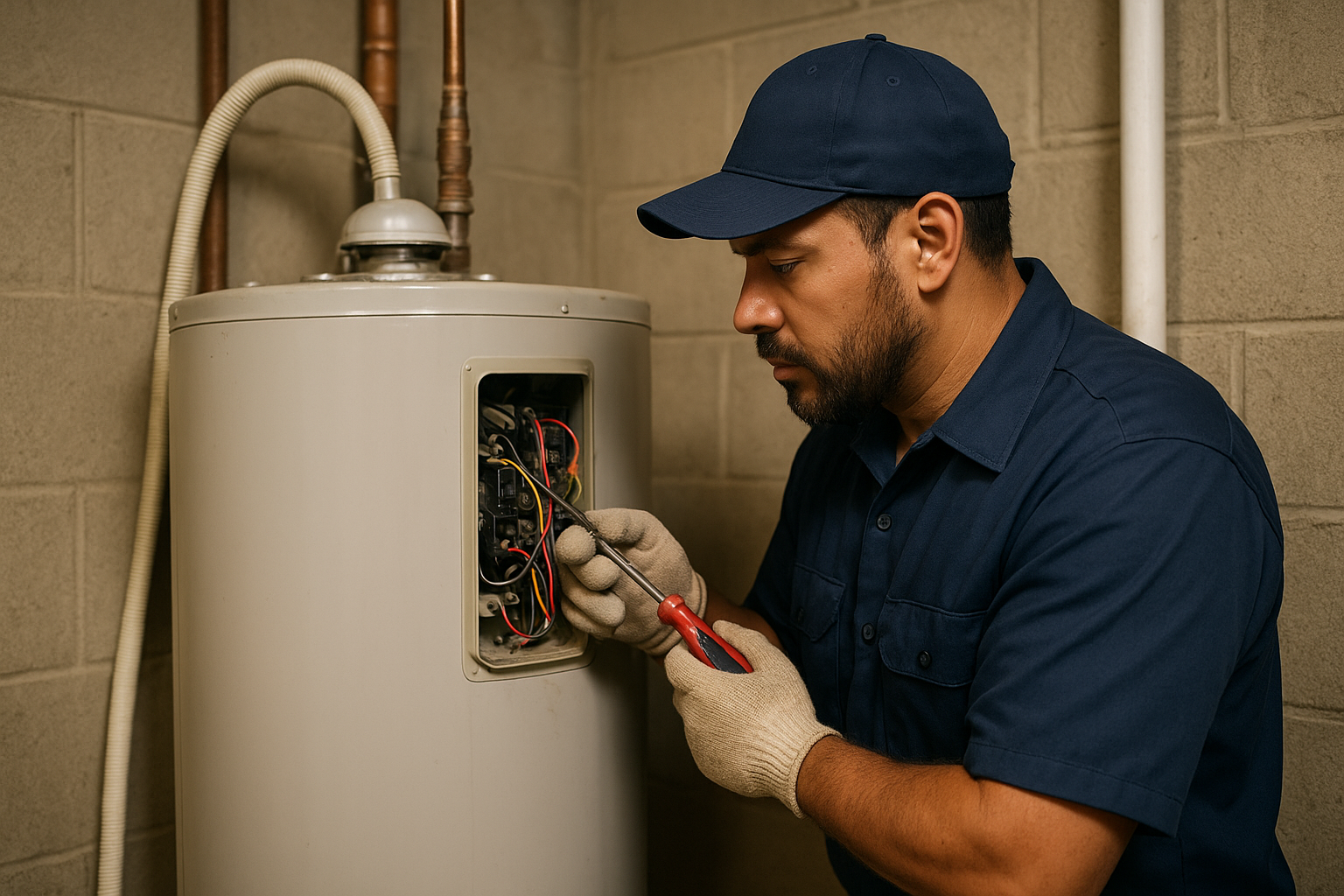
Houston's subtropical climate brings constant humidity that accelerates corrosion on electric water heater terminals and thermostats, especially in homes built before 1990 in the Heights and Montrose. These older properties often have galvanized piping and 30-amp circuits that were never upgraded for modern 4500-watt elements, so technicians routinely find melted wire nuts and pitted contact points that standard replacement kits do not address. Working in tight closets common to River Oaks and Midtown bungalows also means limited airflow during repairs, requiring extra time to verify no moisture remains inside the junction box before re-energizing.
Electric models in Harris County frequently develop sediment buildup on the lower element because city water carries higher mineral content than suburban supplies from Katy or Sugar Land. This scale acts as an insulator, causing the element to overheat and trip the high-limit switch repeatedly. Technicians check both elements and the upper thermostat in one visit because a single failed component can mask a second problem that will surface within weeks if left untouched. Access panels on many 1980s units are painted shut, so removal without damaging the tank jacket is a standard part of the job.
When an electric water heater sits in a Downtown high-rise or Midtown townhome utility room, the lack of combustion air is not an issue, yet the 240-volt supply often shares a panel with multiple high-draw appliances. Voltage drop during peak summer afternoons can make an otherwise good element test marginal, leading to callbacks if the supply is not verified under load. Replacement elements must match the exact wattage and length stamped on the original to avoid voiding any remaining tank warranty and to prevent the new part from failing in the same humid environment within months.
Technician insight
In Houston the thing that catches most people out with Electric Water Heater Repair is how fast the humidity in Heights and Montrose crawlspaces corrodes the terminals on pre-1985 tanks. Homeowners replace the element only to have the new one fail in six months because the wiring was never cleaned and protected.
Montrose Bungalow Element Failure
A 1978 home in Montrose lost hot water during a humid July stretch. Inspection showed the lower element coated in scale and the upper thermostat contacts pitted from moisture. Both elements and the thermostat were replaced, terminals were treated with dielectric grease, and the tank was flushed. Recovery returned to normal and no further trips occurred.
Electric Water Heater Repair Services We Offer
✓Electric Heating Element Replacement
Removes corroded or scaled elements common in Houston's mineral-heavy water and installs matched replacements to restore full recovery rate.
✓Thermostat and High-Limit Repair
Diagnoses and replaces upper or lower thermostats that fail from humidity-induced corrosion in Heights and Montrose homes.
✓Electric Water Heater Wiring Repair
Repairs melted or oxidized connections inside the junction box caused by Houston's constant moisture and older 30-amp circuits.
✓Sediment Flush and Element Cleaning
Drains and flushes tanks to remove insulating scale that shortens element life in Harris County water supplies.
✓Electric Water Heater Leak Repair
Addresses gasket and element seal leaks that appear after repeated overheating cycles in humid utility closets.
Electric Water Heater Repair Cost in Texas
| Service | Typical Range | What Affects It |
|---|---|---|
| Single element replacement | $225–$375 | Higher when access panel is painted shut or wiring needs repair |
| Thermostat replacement | $175–$295 | Includes both upper and lower if needed |
| Full electrical inspection and wiring repair | $150–$350 | Common in Heights and Montrose homes with original 30-amp circuits |
| Sediment flush with element service | $125–$225 | Added when scale is found on lower element |
Ranges are typical for Texas and confirmed with an exact written quote before any work starts.
How it works
- 1
Initial Safety And Power Check
Confirm 240-volt supply is off at the breaker and test for residual voltage at the junction box before any disassembly.
- 2
Element And Thermostat Testing
Remove access covers, test both elements for continuity, and check thermostat calibration under actual voltage conditions.
- 3
Component Replacement
Install new elements or thermostats using dielectric grease on terminals to slow future corrosion from Houston humidity.
- 4
System Verification
Refill tank, restore power, and confirm recovery rate and temperature settings match the home's usage pattern.
Pricing
Upfront quotes after inspection; prices vary by part access and whether older wiring in pre-1990 homes requires additional repairs.